

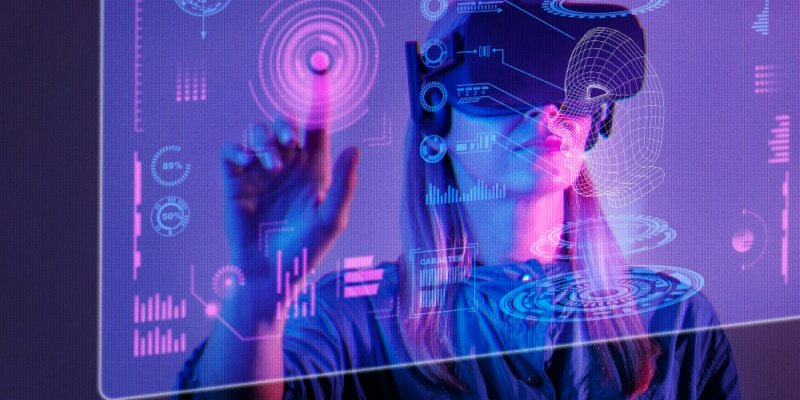
The fear of artificial intelligence isn’t a technology problem. It’s an identity crisis in disguise, and your brain is running the whole show. Every week, a new headline tells you AI is coming for your job. Your industry. Your relevance. And every week, a quiet dread settles somewhere in the chest.
But here’s what no one is saying out loud: The fear isn’t about the machine. It’s about the mirror.
What makes AI genuinely unsettling isn’t that it’s powerful. It’s that it’s measurably comparable to you, in the one domain you were told made you special.
And your brain, ancient and tribal and wired for survival, does not handle that comparison well. This isn’t a motivational reframe.
This is neuroscience. And once you see it, you can’t unsee it.
The Brain Doesn’t See AI as a Tool. It Sees It as a Rival
When we humans are outperformed by another human, beaten in a test, outpaced at work, one-upped in a conversation, specific brain regions light up.
The regions responsible for processing cognitive threat and social pain, become active. The same regions activate when people are exposed to AI outperforming them.
Not the circuits for analyzing tools. Not the circuits for evaluating machinery. The circuits for social humiliation.
Your brain does not classify ChatGPT the way it classifies a calculator or a car, but more of a threat.
It classifies it the way it classifies a person who is smarter, faster, and doesn’t need sleep.
A rival. An interloper in the social hierarchy that your nervous system has been tracking since before language existed.
The brain cannot tell the difference between being outperformed by a human and being outperformed by a model, as both register as the same emergency.
This is why AI anxiety feels different from other technology anxieties. It feels personal. Because neurologically, it is.
It’s Not Job Loss You’re Afraid Of. It’s Proof
If AI fear were purely economic, it would feel like financial stress. Calculable. Containable. Something you could solve with a plan.
But most people don’t describe their AI anxiety that way. They describe it with words like worthless, replaceable, pointless. Those aren’t economic terms. Those are identity terms.
What’s actually happening is a psychological phenomenon called identity-performance fusion.
Me And My Ego
It’s the moment when your self-worth and your productive output become the same variable. When what you produce is who you are.
Most high-performers have this fusion so deeply built in they can’t see it. The work isn’t something they do. It’s something they are.
And when an algorithm matches or beats that output, the brain doesn’t register it as competition. It registers it as evidence, the thing you built your identity on wasn’t as rare as you thought.
That’s not a comfortable truth. But it’s a clarifying one. Because it means the fear was never really about artificial intelligence.
It was about what intelligence meant to you, and whether you’d still matter without it being your defining edge.
The Neural Pathway: Social Death and AI Anxiety
In evolutionary terms, the most catastrophic thing that could happen to a human was not physical death. It was exile. Removal from the group. Social death.
Humans survived because they cooperated. They cooperated because they had value within the group. Remove the value, lose the group. Lose the group, lose everything.
The amygdala, your brain’s threat-detection system still runs on this logic. It doesn’t know you live in 2026. It knows: if you are no longer necessary, you are no longer safe.
The Fear Of Uselessness
And this is where AI fear sinks its real teeth. It’s not triggering a fear of poverty. It’s triggering a much older, deeper signal.
I might become unnecessary. And in the ancient brain, unnecessary and endangered are functionally the same word.
Cortisol doesn’t distinguish between being chased by a predator and being replaced by software. The threat response is identical. The consequences for your health, focus, and decision-making are just as real.
Chronic low-grade AI anxiety doesn’t just feel bad. It narrows cognitive bandwidth, increases reactivity, and makes you less capable in exactly the areas you’re trying to protect.
The anxiety undermines the performance it’s trying to preserve.
The Deeper Question No Algorithm Can Answer
If intelligence was always a tool and not an identity, then AI hasn’t taken anything that was truly yours. What belongs to you, irreducibly and permanently, is not your output.
It’s not your productivity or your processing speed or your ability to synthesize information faster than the next person. What belongs to you is the question underneath all of that:
What do you actually want to call into existence? Which problems move you enough to stay with them through the difficulty? What kind of world do you think is worth building?
These are not optimization questions. They are not prompts. They are not things a model can answer on your behalf. AI has not diminished that.
If anything, it has created the first real pressure to find it, because the people who know exactly why they’re here, who are moved by something beyond performing competence.
The fear of AI is not a sign of weakness. It’s a signal that the identity you built on performance is ready to be replaced by something more durable.
What To Do With This
The practical application of neuroscience is never “just calm down.” The amygdala doesn’t respond to instructions. It responds to evidence, re-categorization, and repeated exposure to new patterns.
Start here. Ask the question that cuts beneath the anxiety: “What would I be if I stopped measuring myself against what AI can do?”
Not what would you do. What would you be. The answer to that question is sitting underneath the fear, waiting for the noise to clear.
The people who are building something remarkable right now aren’t the ones who are less afraid of AI. They’re the ones who stopped confusing their identity with their output.
That shift doesn’t require courage. It requires clarity. And clarity begins the moment you stop looking at AI as a mirror .
Start looking at it as a tool in the hands of someone who knows exactly what they’re building. Start there. Everything else follows.